Online Casino Regulation in Germany and Why It Pushes Players Offshore
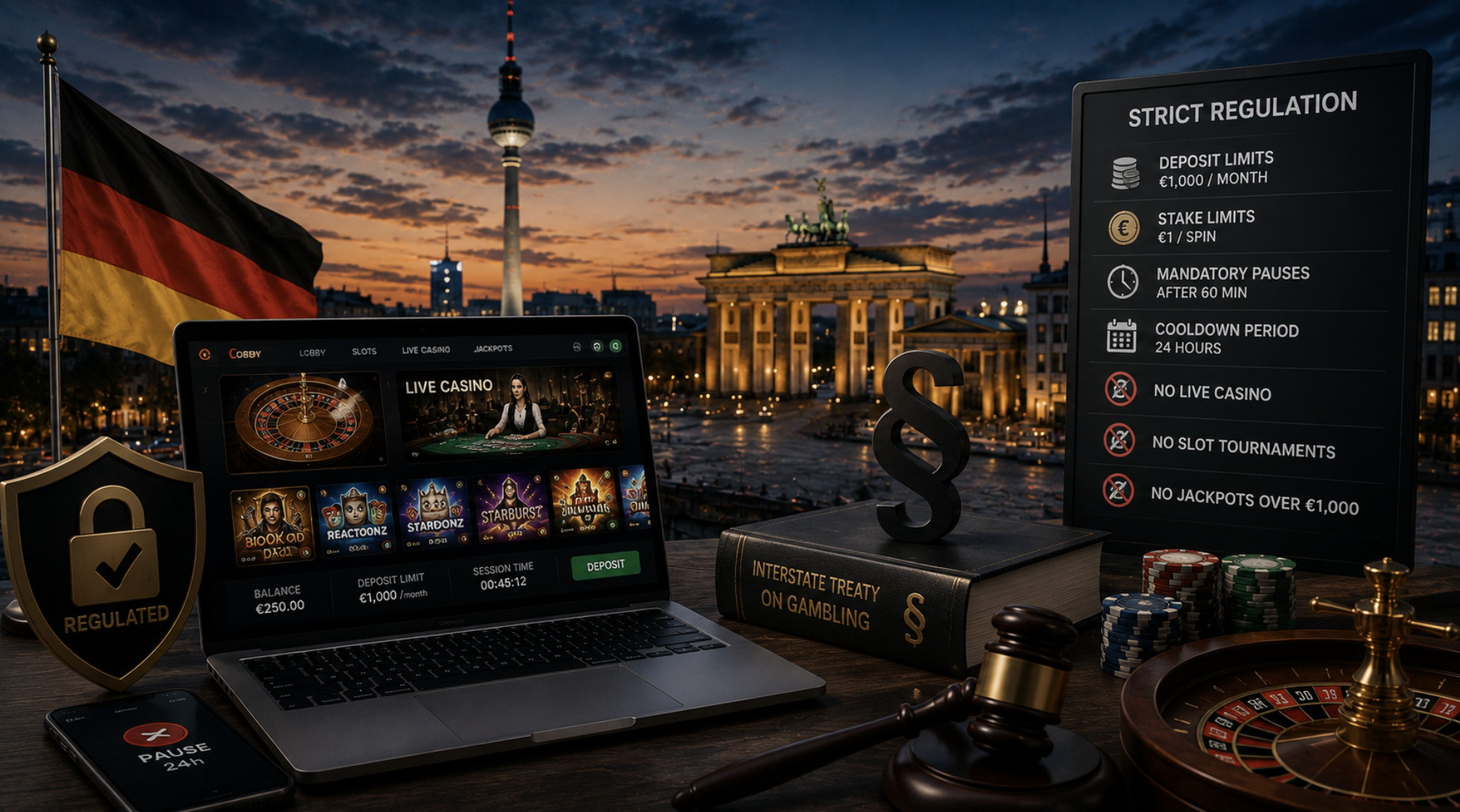
Germany operates one of the strictest regulated online casino markets in Europe, and understanding it is essential for anyone trying to make sense of how online gambling works there. Since online gambling was formally legalised under the Interstate Treaty on Gambling, the market has been governed by an unusually tight set of rules — deposit caps, stake limits, mandatory pauses, and outright bans on entire categories of game. The result is a curious paradox: there is a legal, licensed online casino market, and yet a great many players continue to look at offshore sites instead. This guide explains how the German system works, why it is designed the way it is, and why that design pushes a significant share of players outside it.
The GGL and the regulatory framework
At the centre of the system sits the GGL — the Gemeinsame Glücksspielbehörde der Länder, the joint gambling authority of the federal states. It is the central body responsible for licensing and supervising online gambling, created to bring nationwide consistency to what had previously been a fragmented, state-by-state approach. The GGL is the authority that issues licences and enforces the rules that licensed operators must follow. In principle, this gives the country a unified, regulated market with a single supervising authority — a real improvement in coherence over what came before.
What makes the market distinctive is not the existence of the regulator but the severity of the rules it enforces. The framework was written with harm-prevention as its overriding priority, and it pursues that goal through restrictions far tighter than most other European markets impose. The philosophy is explicit: make regulated online gambling deliberately slow, capped and limited, on the theory that friction and hard limits reduce harm. Whether that philosophy succeeds is exactly the question at the heart of the market's central tension, because those same restrictions are what send many players elsewhere.
The strict limits that define the market
The specifics of the rules are what set this market apart, and they are worth spelling out because they explain everything that follows. Licensed online gambling operates under a monthly deposit limit of €1,000 that applies across operators — a player cannot simply deposit more by moving to another licensed site, because the limit is tracked centrally. Online slot stakes are capped at just €1 per spin, and there is a mandatory delay of around five seconds between spins, deliberately slowing the pace of play. Perhaps most consequentially, licensed sites are not permitted to offer live casino games or progressive jackpot slots at all — entire categories that are standard elsewhere are simply absent.
Taken together, these rules produce a licensed product that is, by design, far more restricted than what players find in most other markets. A €1 maximum stake, a forced pause between every spin, a hard monthly deposit ceiling, and no live dealer tables or progressive jackpots add up to an experience deliberately stripped of much of what many players are looking for. This is not an accident or an oversight; it is the intended outcome of a harm-prevention-first policy. But intentions and effects can diverge, and the effect of making the licensed product this restrictive is to make the unlicensed alternative look, to many players, dramatically more appealing.
OASIS, LUGAS and the protection systems
The approach also relies on centralised technical systems that are genuinely notable, whatever one thinks of the restrictions around them. The most important is OASIS, a cross-provider self-exclusion register: a player can exclude themselves nationally through OASIS, and that exclusion then bars them from every licensed operator at once, rather than requiring them to opt out site by site. Alongside it, the LUGAS system tracks the centralised deposit limit across licensed operators, which is how the €1,000 monthly cap is actually enforced across the whole regulated market rather than per site.
These systems are, in isolation, a serious piece of player-protection infrastructure — a national self-exclusion register and a cross-operator limit tracker are exactly the kinds of tools that make a regulated market safer than an unregulated one. The catch is that they only work for players who stay inside the licensed system. Their strength is also the source of the paradox: the more effectively the licensed market enforces limits and exclusions, the greater the incentive for players who want to escape those limits to go somewhere the systems do not reach. A protection that only protects those who remain inside the fence does little for those who climb over it, and this very effective fence is part of what motivates the climb. Assessing whether any site actually looks after players is a skill in itself, and one worth building before depositing anywhere, as we discussed in how to tell if an online casino is trustworthy before you deposit.
Why players look offshore — and the trade-offs
The consequence of all this is a large offshore pull, and it is not hard to see why. A player who wants to play live dealer games, spin for more than €1, deposit beyond the €1,000 monthly cap, or access progressive jackpots cannot do any of those things at a licensed domestic site, because the rules forbid them. Offshore casino brands, by contrast, offer exactly the features the licensed market strips out — full live casino floors, higher stakes, larger bonuses, and fast, flexible payments including cryptocurrency. A representative example of that offshore, crypto-friendly European style of operator is bearo.net, whose live tables, larger welcome offers and quick crypto payouts embody precisely the features the domestic regulation deliberately removes from the licensed product.
The honest framing, though, has to include the trade-offs, because they are real and significant. A player who moves to an offshore site to escape the restrictions also moves outside the domestic protection systems entirely: no OASIS self-exclusion, no LUGAS deposit tracking, no local regulator to turn to if a dispute arises. The very limits that make the offshore market attractive are, from a harm-prevention standpoint, the point of the system — and leaving that system means leaving its safeguards behind along with its restrictions. This is the genuine dilemma at the heart of the market: the licensed side is highly protective but restrictive, the offshore side is unrestricted but unprotected, and each player is effectively choosing which of those trade-offs they prefer. There is no option that offers both the freedom and the safety net at once. The broader forces reshaping this whole landscape are worth understanding too, a subject we explored in the forces quietly shaping the next era of online casinos.
What players should take away
For a player here, the practical understanding to hold onto is that the licensed market is a deliberate bargain: strong protections and hard limits in exchange for a deliberately restricted experience. The €1 stake cap, the €1,000 monthly deposit limit, the five-second spin delay, and the absence of live casino and progressive jackpots are not bugs but the defining features of a harm-prevention-first design. Whether that bargain suits a given player is a personal judgement — but it should be made with full awareness of what lies on the other side of it.
The offshore alternative removes the restrictions and, with them, the protections, and no amount of marketing changes that structural fact. The genuinely responsible approach for anyone weighing the two is to recognise that the limits exist for a reason rooted in harm reduction, and that escaping them means taking on the responsibility those systems were built to carry. Whatever a player decides, the universal principles hold with particular force in a market designed around them: gambling is entertainment, never a way to make money or chase losses, and setting firm limits — whether the regulator enforces them or you do — is the single most important safeguard. Help and self-exclusion through OASIS are available to any player who needs them, and reaching for those tools is always the stronger move.
Frequently asked questions
Is online casino gambling legal in Germany? Yes. Online gambling is legal under the Interstate Treaty on Gambling and is licensed and supervised by the GGL (Gemeinsame Glücksspielbehörde der Länder). However, the licensed market operates under some of the strictest rules in Europe.
What are the main restrictions on licensed German online casinos? A €1,000 monthly deposit limit tracked across operators, a maximum stake of €1 per slot spin, a mandatory delay of around five seconds between spins, and a ban on live casino games and progressive jackpot slots at licensed sites. Self-exclusion is handled nationally through the OASIS register.
Why do German players use offshore casinos? Because licensed domestic sites forbid features many players want — live dealer games, higher stakes, deposits above the €1,000 cap, and progressive jackpots — while offshore brands offer them along with larger bonuses and crypto payments. The trade-off is that offshore sites sit outside protections like OASIS and the central deposit-limit system.